The Volunteers Who Actually Keep Weston's Trails Open
September 10, 2026
September 10, 2026
Walk the Jericho Town Forest Loop off Warren Avenue on a September morning and you'll pass a fire road, a stretch of low blueberry under the pines, and eventually the granite trailhead markers near the Legacy Trail. Almost nobody stops to read the small compass rose set into that stone-dust path. It's a memorial to George Bates, a former Conservation Commissioner who spent years as the treasurer of an organization most Weston residents walk through without ever joining: the Weston Forest and Trail Association.
Here's the part that tends to surprise people who have lived here for years. That group, not the town, does most of the physical work of keeping the trail network open. WFTA maintains more than 100 miles of trails across the roughly 2,000 acres of conservation land the town owns and protects, a network that includes the 3.8-mile Jericho Town Forest loop off Warren Avenue alone, and it does this with fewer than 300 dues-paying members. The Conservation Department owns the land and sets policy. WFTA cuts back the growth, clears the downed trees, and keeps the maps current.
That gap between how big the resource is and how few people fund it is the thing worth understanding before you lace up for fall.
When a tree comes down across a trail in Nolte Forest or Fiske Town Forest, it doesn't get reported to a town crew with a truck and a schedule. It gets handled by a volunteer group inside WFTA that calls itself the Chainsaw Brigade, roughly fifteen people who show up when a downed tree, sometimes a genuine widowmaker, gets flagged. WFTA also hires and pays for one professional trail maintenance worker to handle the routine clearing across those 90-plus miles, which means the entire system rests on one paid position and a rotating bench of volunteers.
This matters if you've ever assumed the trails are a town service like snow plowing. They aren't. WFTA was formed in 1955 specifically because residents wanted the open space protected, and it still runs largely on membership dues and the kind of unpaid labor that doesn't show up in any town budget line. The organization owns more than 200 acres of that conservation land outright, on top of what it maintains for the town.
If you want to see this operation in person rather than read about it, WFTA is holding its Trailblazer Party on Friday, September 11, from 5:00 to 7:30 PM, with live music, food trucks, and a chance to hear directly from the people who do the cutting and clearing about what's changed on the trail system this year.
Fall is when off-leash walking season peaks in Weston, and it's also when the rule inconsistencies catch the most people off guard. Voice-control off-leash walking is permitted on much of Weston's conservation land, but not on all of it, and the exceptions are specific enough to trip up longtime dog owners, not just newcomers.
| Location | Leash rule |
|---|---|
| Most Weston conservation land | Off-leash allowed under voice control |
| Mass Central Rail Trail | Leash required |
| Case Estates | Leash required |
| Legacy Trail and its connectors | Leash required |
Commercial dog walkers face an added restriction: no more than five dogs at a time, and a permit is required. The pattern isn't arbitrary. The Legacy Trail and Case Estates see heavier mixed use from strollers and walkers who aren't there for an off-leash romp, which is part of why the Legacy Trail exists in its current form at all. Built with Community Preservation Act funding approved at Town Meeting in 2019, the stone-dust surface meets U.S. Forest Service accessibility guidelines, replacing a soft-surface path that had been genuinely difficult for anyone using a stroller or a walker to get to the Case Estates rhododendron gardens, plantings that were expanded decades ago under the direction of the Massachusetts Chapter of the American Rhododendron Society.
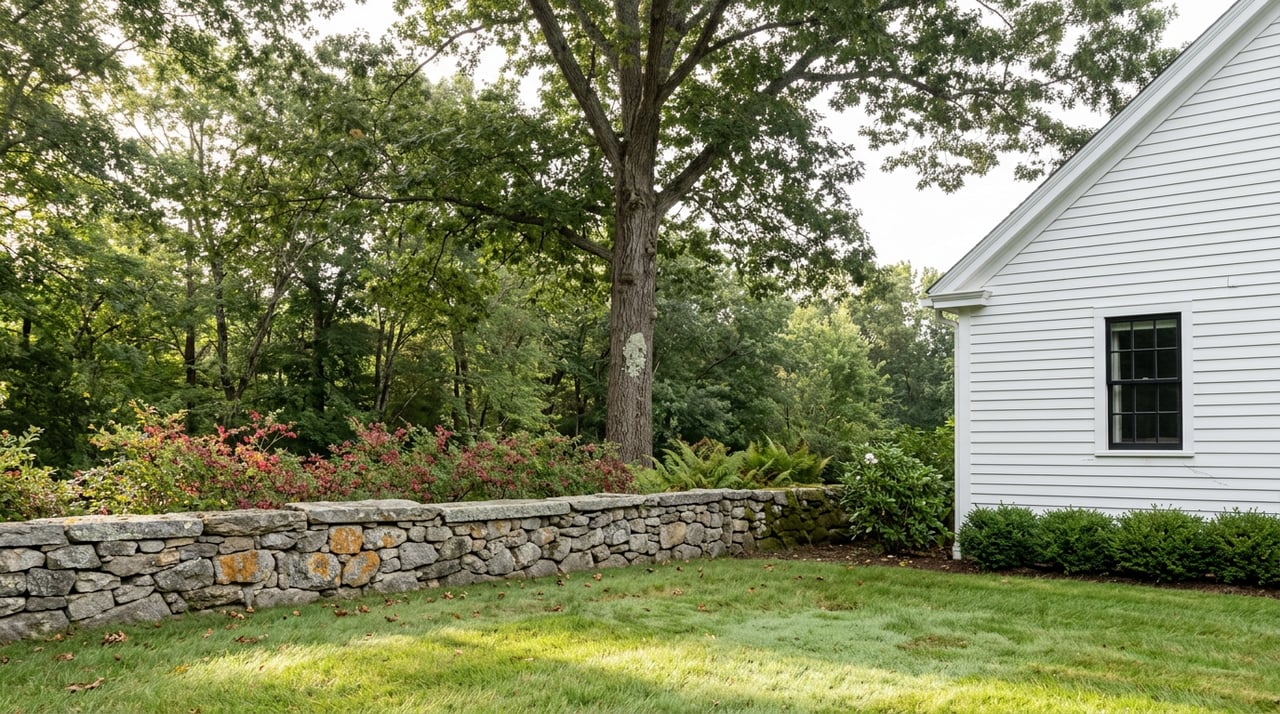
Two details worth knowing if you walk the Legacy Trail this fall: the granite trailhead markers and entrance pillars were salvaged from the old Sears Estate and the original Field School, and roughly 200 feet of the stone wall along one edge of the property was a 1911 birthday gift from Marian Case to her sister Louisa. It's been described as the largest free-standing dry-laid wall in New England.
Land's Sake operates on the same logic as WFTA: a nonprofit doing real work that happens to double as a favorite weekend destination. The farm works a 35-acre field within the Case Estates that the town bought in 1986 and still leases to Land's Sake, and it donates a third of its harvest to local hunger relief organizations at a moment when food insecurity in Massachusetts is at its highest recorded rate, with roughly one in three residents affected. The farmstand also just added Blackbird Doughnuts to its list of regular offerings, alongside the produce, flowers, and coffee that keep people coming back on weekday mornings.
This fall, the farm's biggest ask of the year lands over one weekend. Harvest Dinner runs Saturday, September 26, from 5:30 to 9:00 PM, a farm-formal evening with cocktails, a seated dinner, and a live auction that funds the hunger relief program and general farm operations. Pie Fest follows on Sunday, September 27, a family event built around live music, a pie-eating contest, and the kind of fall treats that don't need much explanation. Together they're the single largest fundraising weekend Land's Sake runs each year, which is worth knowing if you've attended Pie Fest for the pies without realizing the dinner the night before is what keeps the farm's hunger relief commitments funded through the winter.
None of this changes anything about how you'd use the trails or the farmstand day to day. What it should change is the assumption that these are simply amenities that come with living in Weston, maintained somewhere behind the scenes by people whose job it is. The trail system and the farm are both run by small nonprofits operating on tight margins and volunteer hours, and the fall calendar, the Trailblazer Party on September 11 and Harvest Weekend on September 26 and 27, is literally how both organizations ask the town to notice them.
If you're looking for a loop to walk before either event, the Doublet Hill Loop climbs 278 feet, the steepest elevation gain of any trail in town, and rewards you with a rocky outcrop view toward downtown Boston. Sanderson Hill, reached through the old harness-racing track paths of Highland Forest, was a beacon site during the Revolutionary War and still offers a sightline toward Nobscot Hill and Mount Wachusett on a clear day. Hemlock Pond, off the Doublet Hill tract, still has the two wrought iron chairs from when it served as a neighborhood swimming hole.
Weston's rural character isn't an accident of zoning. It's the accumulated result of a nonprofit that's been quietly stewarding this land since 1955 and a farm that's been feeding both the town and its neighbors in need for decades. Both institutions are easy to take for granted precisely because they've done their jobs well enough that most residents never have to think about who's actually doing the work.
That same instinct, showing up for the town in ways that don't always get noticed, is part of why Denise Mosher directs a portion of every commission to a charity her clients choose. If you're weighing a move in Weston or simply want a clearer read on what your property is worth in today's market, request a complimentary home valuation and start the conversation.
Stay up to date on the latest real estate trends.